The Psychology of Identity, Ego, and the Wilderness Within
Some stories endure because they happened.
Others endure because they keep happening.
Whether you approach the story of Jesus in the wilderness as sacred history, spiritual metaphor, or psychological reflection, one thing is difficult to ignore:
It continues to ask questions that feel remarkably alive.
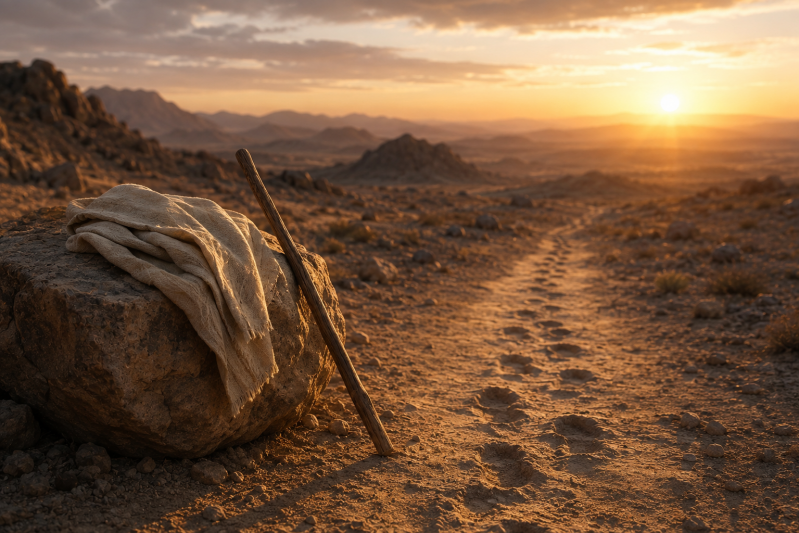
For forty days, Jesus enters the wilderness.
He fasts.
He is alone.
And then, at his weakest, comes temptation.
For many people, this story is about resisting evil.
But I wonder if there is another lens worth holding beside it.
Not instead of.
Alongside.
A psychological lens.
One that asks not only, “What happened?”
But, “What keeps happening inside each of us?”
⸻
The temptations themselves are surprisingly ordinary.
Turn stones into bread.
Throw yourself from the temple.
Rule the kingdoms of the world.
At first glance, they seem unrelated.
But the longer I sat with them, the more I noticed something curious.
Each temptation quietly asks the same question.
Who are you?
Not through words.
Through identity.
The first whispers,
“You are your physical needs.”
The second whispers,
“You are what others think of you.”
The third whispers,
“You are what you possess, control, or achieve.”
Three different invitations.
One underlying message.
Become something smaller.
⸻
That observation reminded me of Carl Jung.
Jung spent much of his life warning against what he called over-identification.
Not because identity itself is a problem.
Identity is necessary.
We all need names, roles, responsibilities, and a sense of continuity.
The problem begins when we mistake one part of ourselves for the whole.
When we become only the achiever.
Only the parent.
Only the wounded child.
Only the successful one.
Only the failure.
Only the diagnosis.
Only the trauma.
Only the title.
Every time we say, “This is all I am,” we quietly step into a smaller room than the one we were born to inhabit.
⸻
This is why I hesitate whenever I hear people describe the ego as an enemy.
Psychologically speaking, the ego isn’t something we should destroy.
It’s part of how we navigate the world.
It helps us make decisions, maintain boundaries, and organize experience.
Without it, daily life would become impossible.
The challenge isn’t having an ego.
The challenge is forgetting there is something larger than it.
Awareness.
The quiet part of us capable of noticing thoughts without immediately becoming them.
The part that can witness fear without concluding, “I am fear.”
Witness grief without believing, “I am only grief.”
Witness success without deciding, “This is my worth.”
Awareness doesn’t erase experience.
It simply refuses to reduce identity to a single experience.
⸻
That may be why the sequence of the temptations fascinates me.
Notice what happens.
They don’t become darker.
They become subtler.
First comes comfort.
Then recognition.
Then power.
Not because these desires are inherently wrong.
But because they become dangerous when we ask them to answer a question they were never meant to answer.
Who am I?
Comfort cannot answer that.
Recognition cannot answer that.
Power cannot answer that.
Neither can achievement.
Neither can suffering.
Neither can admiration.
They can describe parts of our experience.
They cannot contain the whole of us.
⸻
Perhaps that’s the deepest temptation any of us face.
Not becoming evil.
Becoming reduced.
The world offers endless opportunities to mistake ourselves for something partial.
Your productivity.
Your appearance.
Your social media following.
Your income.
Your political beliefs.
Your relationship status.
Even your healing.
How easily we begin introducing ourselves through the smallest rooms we’ve built.
And then wonder why we feel confined.
⸻
The wilderness itself begins to look different through this lens.
Perhaps it isn’t simply a desert.
Perhaps the wilderness is any season where the identities we’ve relied upon stop working.
A career ends.
A relationship changes.
Children leave home.
Our bodies become ill.
A diagnosis arrives.
Retirement begins.
Grief rearranges everything.
Suddenly, the roles that once told us who we were begin to fall away.
It feels disorienting.
Sometimes frightening.
Yet almost every wisdom tradition tells a remarkably similar story.
Transformation rarely begins in certainty.
It begins where certainty can no longer protect us.
The wilderness strips away what is temporary.
Not to punish us.
But to ask a quieter question.
Who remains?
⸻
I wonder if this is why so many people describe life’s hardest seasons as strangely clarifying.
Not because suffering is good.
It isn’t.
But because suffering often interrupts the stories we’ve been telling ourselves.
When everything familiar disappears, we begin searching for something that cannot be taken away.
A deeper identity.
One that isn’t dependent on applause.
Or titles.
Or productivity.
Or perfection.
Perhaps this is why so many people emerge from profound hardship saying,
“I don’t feel like the same person.”
Maybe they aren’t.
Or perhaps, for the first time in a long time…
they’ve stopped mistaking themselves for everything they were carrying.
⸻
This doesn’t mean abandoning ambition.
Or relationships.
Or goals.
Or success.
It means holding them differently.
With open hands.
Allowing them to become expressions of who we are rather than definitions of who we are.
There is tremendous freedom in that shift.
Because what can be lost no longer has to carry the impossible burden of telling us who we are.
⸻
Maybe that is the quiet invitation hidden within the wilderness.
Not simply to resist temptation.
But to remember.
To remember that awareness is always larger than any passing thought.
That identity is always deeper than any passing role.
That your worth was never meant to be negotiated by comfort, applause, or power.
And perhaps the greatest temptations in life are rarely invitations to become evil.
More often…
they are invitations to become smaller than you truly are.
⸻
Closing Reflection
If this piece leaves you with one question, let it be this:
What story about yourself have you quietly mistaken for your whole identity?
Not because that story is false.
Many of our stories are profoundly true.
You may have experienced unimaginable grief.
You may have achieved extraordinary things.
You may carry scars that deserve to be honoured.
The invitation isn’t to deny any of that.
It’s simply to remember that none of it is large enough to contain the whole of who you are.
Perhaps awareness isn’t asking us to abandon our stories.
Perhaps it is gently reminding us that we are always larger than the stories we are living through.
And perhaps that is what every true wilderness has been trying to reveal all along.
Not a smaller self…
but a deeper one.
⸻
Add comment
Comments