Newgrange and the Lost Art of Wonder: What a 5,000-Year-Old Tomb Teaches Us About Being Human
There is an ancient monument in Ireland that has quietly been waiting for sunrise for more than five thousand years.
Once each year, on the morning of the winter solstice, something extraordinary happens.
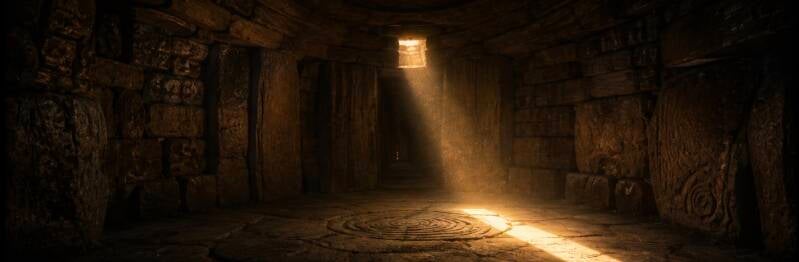
For approximately seventeen minutes, the rising sun enters a small opening above the entrance, travels nineteen metres down a narrow stone passage, and illuminates a chamber that has spent the rest of the year in complete darkness.
It is called Newgrange.
Built around 3200 BC, it is older than Stonehenge.
Older than the Egyptian pyramids.
Constructed by people who left us no written language, worked without metal tools, and built something so carefully aligned that, thousands of years later, it still welcomes the returning light.
For generations, archaeologists puzzled over a curious opening above the entrance. It seemed too deliberate to be decorative, yet no one understood its purpose.
Then, in 1967, archaeologist Michael O’Kelly stood inside the chamber before dawn on the winter solstice.
As the sun rose, the answer revealed itself.
A single beam of light travelled the length of the passage and reached the heart of the monument.
The builders had been waiting five thousand years for someone to notice.
⸻
We Have Been Telling the Wrong Story About Our Ancestors
There is a quiet assumption woven through modern culture.
We often imagine that history is a steady march from ignorance to intelligence.
That ancient people were somehow less sophisticated because they lacked our technology.
Newgrange refuses that story.
Its builders understood the movement of the sun with extraordinary precision.
Not through satellites.
Not through software.
Through observation.
Year after year.
Generation after generation.
Imagine the patience this required.
No search engine.
No astronomy app.
No clock.
Just careful attention to the horizon.
The sky became their textbook.
The seasons became their calendar.
Perhaps intelligence has always existed.
It has simply expressed itself through different tools.
⸻
The Intelligence of Paying Attention
Today, information arrives almost effortlessly.
Our challenge is rarely finding knowledge.
It is staying with anything long enough for it to change us.
The people who built Newgrange remind us that there is another kind of intelligence.
Not the intelligence of accumulating more facts.
The intelligence of sustained attention.
To notice where the sun rises.
To notice when the shadows shift.
To notice patterns so subtle they reveal themselves only after years of patient observation.
Perhaps wisdom has never depended solely on knowing more.
Perhaps it also depends on learning to notice more.
⸻
When Knowledge and Wonder Were Never Separate
One sentence kept returning to me as I learned about Newgrange.
They didn’t separate the science of the sky from the meaning they made of it.
The same observations that allowed them to predict the winter solstice became part of a ritual honouring those who had died.
Astronomy wasn’t competing with reverence.
It became an expression of it.
Today we often ask whether something belongs to science or spirituality.
As though they occupy opposite sides of the room.
Newgrange quietly suggests another possibility.
Perhaps those categories are newer than we imagine.
The people who built this monument seemed perfectly comfortable allowing careful observation and profound meaning to exist together.
Not because one proved the other.
Because both emerged from the same relationship with the world.
Knowledge told them where the sun would rise.
Love told them why it mattered.
⸻
The Loss of Cosmic Participation
One phrase has stayed with me ever since I first encountered this story.
Cosmic participation.
We know when the winter solstice arrives because our phones remind us.
The builders of Newgrange knew because they lived inside the rhythm of the seasons.
They did not simply observe nature.
They participated in it.
The returning light was not information.
It was an event they prepared themselves to receive.
There is a quiet difference between understanding the Earth’s orbit and standing outside before dawn to watch the first light return after the longest night of the year.
One is knowledge.
The other is relationship.
Perhaps one of the great losses of modern life isn’t that we’ve become less spiritual.
Perhaps it’s that we’ve become less participatory.
We know more about the universe than any generation before us.
Yet many of us spend remarkably little time feeling that we belong within it.
⸻
The Psychology of Seventeen Minutes
Of everything I learned about Newgrange, one detail lingered longer than the rest.
The light lasts for only seventeen minutes.
Five thousand years of endurance.
Seventeen minutes of illumination.
At first, that seems almost disproportionate.
Until you remember how human transformation often works.
Insight rarely arrives gradually.
Healing can emerge from a single conversation.
Grief can soften in one unexpected moment.
Forgiveness may take years to prepare for…
and only seconds to choose.
The moment itself is often brief.
What changes us is everything that prepared us to receive it.
Perhaps the builders understood something we still struggle to remember.
Some moments become sacred not because they last.
But because we build our lives in such a way that we are ready when they arrive.
⸻
A Chamber for the Light
I don’t think Newgrange has survived for five thousand years simply because it is an impressive feat of engineering.
It has endured because it speaks a language every generation still understands.
Darkness.
Waiting.
The return of light.
Whether we interpret that psychologically, spiritually, scientifically, or poetically hardly matters.
The image continues to resonate because the experience continues to belong to us all.
Every life contains winters.
Every heart knows seasons when hope feels impossibly distant.
And yet the winter solstice quietly reminds us of something both astronomy and psychology agree upon.
The turning toward light begins before most of us can perceive it.
The longest night is not the end of the story.
It is the moment the story begins to turn.
⸻
Perhaps This Is What Wisdom Looks Like
Maybe the greatest lesson hidden inside Newgrange has nothing to do with archaeology.
Maybe it is an invitation.
To pay closer attention.
To hold knowledge and wonder in the same hands.
To remember that understanding the mechanics of the universe does not diminish its beauty.
If anything…
it deepens it.
The people who built Newgrange did not seem interested in choosing between precision and reverence.
They watched the heavens carefully enough to understand their rhythms…
and loved deeply enough to let those rhythms become a language for remembering the people they had lost.
Perhaps that is what wisdom has always looked like.
Not knowing everything.
But allowing what we know to deepen how we belong.
⸻
Sometimes I wonder if the opposite of wonder isn’t skepticism.
It isn’t certainty either.
Perhaps the opposite of wonder is forgetting that we are participants rather than spectators.
Our ancestors looked at the sky and found a relationship.
We often look at the same sky and find information.
Both matter.
But only one asks something of us.
Perhaps the invitation has never been to choose between science and meaning.
Perhaps the invitation is to let careful observation become a form of reverence.
To stand beneath the returning light…
not simply knowing why it appears—
but remembering, if only for a moment,
that we have always belonged beneath it.
⸻
Add comment
Comments