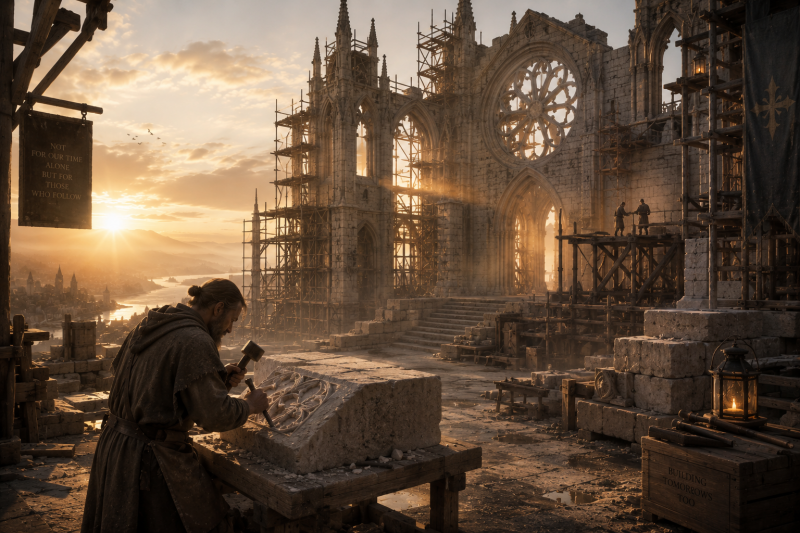
Optimism Bias: Why Your Brain Was Designed to Believe Tomorrow Could Be Better
If you ask psychology to list the quirks of the human mind, optimism bias almost always makes the list.
It sounds clinical.
Almost like a defect.
A built-in error in our thinking.
Psychologists use the term to describe our tendency to believe that positive events are more likely to happen to us than statistics would predict, while negative events feel somehow less likely to happen to us personally.
We know accidents happen.
We simply imagine they’ll happen to someone else.
We know relationships sometimes end.
We quietly believe ours will be different.
We know businesses fail.
Yet countless people still decide to build one.
At first glance, it seems irrational.
And yet…
What if the question isn’t, “Why are humans so unrealistic?”
What if the better question is:
“Why would evolution preserve this tendency in so many of us?”
Sometimes what looks like a flaw is actually an adaptation.
Perhaps optimism bias isn’t evidence that the human mind is poorly designed.
Perhaps it’s evidence that it was designed for movement.
⸻
The Humans Who Believed the Impossible
Imagine our ancestors standing at the edge of an unknown forest.
Or looking across an ocean they had never crossed.
Or deciding to build a home where none had existed before.
If they had calculated every danger with perfect realism, many of those journeys may never have begun.
Every meaningful step into the unknown carries uncertainty.
Love.
Parenthood.
Starting over after loss.
Writing the first page.
Leaving a familiar job.
Healing from trauma.
None of these come with guarantees.
Yet humans keep choosing them.
Perhaps optimism bias is one of the quiet forces that whispers:
“Take one more step.”
Not because success is certain.
But because movement itself has always been necessary for survival.
Sometimes believing tomorrow could be better becomes the very thing that allows tomorrow to exist.
⸻
When Hope Becomes Denial
Like nearly every adaptation our minds have developed, optimism bias has two faces.
The same tendency that encourages courage can also encourage avoidance.
It can convince us that consequences belong to other people.
That illness won’t happen to us.
That our habits don’t matter.
That someone else’s story could never become our own.
Hope becomes dangerous when it refuses to acknowledge reality.
Not because hope itself is the problem.
Because certainty has quietly replaced curiosity.
Healthy hope says:
“This may be difficult… and I believe I can meet it.”
Denial says:
“This won’t be difficult.”
Those two sentences may sound similar.
Psychologically, they couldn’t be more different.
One walks with uncertainty.
The other pretends uncertainty doesn’t exist.
⸻
What Jung Might Have Noticed
Carl Jung often wrote about the danger of unconsciousness.
Not because unconscious processes are bad.
But because anything unconscious has the potential to guide us without our awareness.
Optimism bias feels remarkably similar.
It quietly shapes our expectations long before we realize it’s happening.
It whispers that somehow the ordinary rules of life may bend in our favor.
Sometimes that whisper becomes the beginning of remarkable courage.
Sometimes it becomes the beginning of self-deception.
The task isn’t to silence that voice.
It’s to recognize when it’s speaking.
Awareness doesn’t destroy hope.
It matures it.
⸻
The Story Your Nervous System Is Rehearsing
There is another layer that fascinates me even more.
I don’t think our predictions are only about probability.
I think they’re about identity.
Our brains are constantly trying to anticipate what comes next.
But those predictions aren’t made from mathematics alone.
They’re built from memory.
Attachment.
Experience.
Meaning.
The stories we’ve spent years telling ourselves.
If your nervous system has learned that the world is fundamentally dangerous, tomorrow often looks threatening before it even arrives.
If your nervous system has learned that repair is possible, tomorrow begins to hold possibility.
Our expectations become less like weather forecasts…
and more like autobiographies.
Sometimes what we’re predicting isn’t the future.
It’s the person we believe ourselves to be.
⸻
Hope and Humility
There is an interesting finding in psychology.
Some research suggests that people experiencing depression show less optimism bias in certain laboratory tasks than people without depression—a controversial idea sometimes called depressive realism. The evidence is mixed, and it certainly doesn’t mean depression produces universally accurate thinking. But it raises a fascinating question.
Perfect realism may not always be the healthiest way to move through the world.
Perhaps human flourishing has never required perfect prediction.
Perhaps it requires something gentler.
Hope…
tempered by humility.
Hope that can look directly at uncertainty without pretending it isn’t there.
Hope that can acknowledge risk without surrendering to fear.
Hope that says:
“I know I cannot control every outcome.
But I don’t need certainty before I take the next step.”
That kind of hope isn’t naïve.
It is profoundly courageous.
⸻
A Lantern, Not a Promise
Perhaps optimism bias doesn’t exist to convince us that life will always be easy.
Perhaps it exists because human beings were never meant to wait until certainty arrived before they began living.
The goal isn’t to become perfectly objective.
Nor is it to become endlessly optimistic.
The invitation is something quieter.
To become aware of the stories your mind is telling…
without forgetting why it learned to tell them.
Because somewhere deep within the architecture of being human is a remarkable truth.
Our minds don’t only protect us from danger.
Sometimes…
they also protect our willingness to hope.
And perhaps wisdom isn’t extinguishing that hope.
Perhaps wisdom is learning to carry it like a lantern.
Not because it guarantees the road ahead.
But because it gives us just enough light to keep walking.
⸻
Maybe psychological maturity isn’t becoming less hopeful.
Maybe it’s becoming hopeful enough to look reality in the eye.
To acknowledge uncertainty without being ruled by it.
To understand that courage has never required certainty.
Only the willingness to take one honest step into the unknown.
And perhaps that is why hope has survived every generation before us.
Not because it promised safe passage.
But because it reminded ordinary people that the next step was still worth taking.
⸻
Add comment
Comments