A Crisis Has a Centre
One of the simplest things I’ve read in a long time made me stop scrolling.
It said:
“Trauma makes you the calmest person in a crisis and the most overwhelmed person in a grocery store.”
Like most things shared online, it was an oversimplification.
But sometimes an oversimplification points toward something worth becoming curious about.
Because while that sentence won’t describe everyone who has experienced trauma, it does describe a pattern many people recognize.
And I don’t think it’s actually about grocery stores.
I think it’s about attention.
⸻
When we picture trauma, we often imagine someone who falls apart under pressure.
But that isn’t always what happens.
Many people who’ve lived through difficult experiences become remarkably capable during genuine emergencies.
They’re the person who calls 911 while everyone else freezes.
The one who calmly takes charge after an accident.
The nurse, paramedic, firefighter, counsellor, crisis worker, or parent who somehow becomes clearer the more chaotic things become.
It isn’t because they enjoy emergencies.
It’s because something fascinating happens inside the nervous system.
A crisis has a centre.
There is one problem.
One priority.
One direction.
Everything that doesn’t matter disappears into the background.
Attention narrows.
Energy organizes itself.
The nervous system knows exactly where to send its resources.
For a system that has spent years learning to scan, anticipate and respond, there can be something strangely coherent about that moment.
Not peaceful.
But organized.
⸻
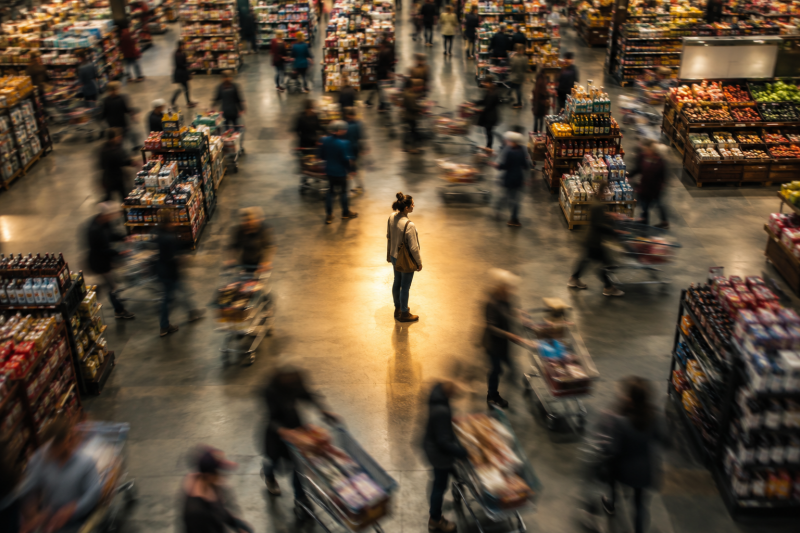
Now compare that to walking into a crowded grocery store.
Nothing is technically wrong.
No emergency.
No obvious threat.
Yet suddenly there are fluorescent lights overhead.
Shopping carts approaching from every direction.
Children crying.
Music playing.
Announcements over the speakers.
Someone standing just a little too close.
Hundreds of products asking for decisions.
People stopping unexpectedly in the middle of the aisle.
Conversations happening all around you.
Individually, none of these things matter very much.
Collectively…
they all ask for a tiny piece of your attention.
And that changes everything.
⸻
We often think overwhelm is caused by doing something difficult.
But many forms of overwhelm aren’t created by difficulty.
They’re created by dispersion.
Not one demanding thing.
Fifty small ones.
Your brain isn’t trying to solve a single meaningful problem.
It’s trying to decide which of forty competing signals deserves your awareness next.
For many people, that’s far more exhausting.
⸻
I wonder if we’ve misunderstood resilience.
Maybe resilience isn’t always the ability to carry more.
Maybe sometimes it’s the ability to carry less at once.
To let attention gather instead of scatter.
To move toward one thing instead of twenty.
⸻
There’s another piece of this that fascinates me.
A genuine crisis gives us permission.
Permission to stop multitasking.
Permission to ignore everything except what matters.
Permission to become completely present.
No one expects you to answer emails while performing CPR.
No one asks whether you’ve remembered to buy toothpaste while helping someone through an emergency.
Life itself narrows the field.
The nervous system doesn’t have to decide what deserves attention.
Reality has already decided.
Ordinary life rarely offers that gift.
⸻
Most days ask us to divide ourselves.
Answer the message.
Remember the appointment.
Compare the prices.
Smile politely.
Watch the traffic.
Choose what’s for dinner.
Notice the person behind you.
Don’t forget the birthday.
Reply to the email.
Pick up the prescription.
Make another decision.
Then another.
Then another.
It’s remarkable we aren’t all more overwhelmed than we are.
⸻
Perhaps that’s why so many people quietly think something is wrong with them.
“I can comfort someone through the worst day of their life…”
“So why does walking through Costco make me want to leave my cart and go home?”
Maybe those experiences aren’t contradictory.
Maybe they reveal something important.
The issue isn’t your capacity.
It’s where your capacity is being asked to go.
⸻
Trauma often teaches the nervous system to become exquisitely aware of the environment.
That adaptation can become an extraordinary strength.
It helps people notice what others miss.
It allows them to respond quickly under pressure.
To stay present when others become overwhelmed.
Many helpers, caregivers, emergency workers and therapists quietly carry this gift.
But every gift has an energetic cost.
The same awareness that becomes invaluable during meaningful moments can become exhausting when there is no single place for it to land.
⸻
Maybe overwhelm isn’t always evidence that you’re fragile.
Maybe it’s evidence that your attention has been pulled in too many directions for too long.
Maybe the question isn’t:
“Why can’t I handle this?”
Maybe the question is:
“How many things am I asking one nervous system to hold right now?”
Those are very different questions.
And they lead to very different kinds of compassion.
⸻
One sentence has stayed with me ever since I read that meme.
Not the grocery store part.
This part:
A crisis has a centre.
Perhaps that’s why some people appear so calm when life becomes chaotic.
Not because they’re built for crisis.
But because, for one brief moment…
everything they are carrying finally has one clear place to go.
Maybe healing isn’t becoming someone who can hold an infinite number of things at once.
Maybe healing is slowly remembering that your attention was never meant to live scattered across forty different directions.
Perhaps it was always meant to come home to one.
⸻
From the Curiosity Desk
What if overwhelm isn’t always your nervous system saying, “This is too much”…
What if, sometimes, it’s gently whispering,
“Please don’t ask me to be everywhere at once.”
Add comment
Comments