
Belonging Was Never a Luxury. It Was Always a Biological Need.
Most of us think of loneliness as an emotion.
A difficult evening.
A quiet house.
A season of life that feels a little emptier than we'd hoped.
But your body has never understood loneliness that way.
It never has.
Long before cities, careers, smartphones, and social media, human beings survived because we survived together. For most of our history, separation from the group wasn't simply painful—it was dangerous. There was less protection, less warmth, fewer resources, and sometimes no one to notice if you didn't return.
Your nervous system still remembers that world.
Research over the past two decades has found that people experiencing chronic feelings of loneliness often show measurable changes throughout the body. Scientists have observed shifts in immune-related gene expression, increases in inflammatory activity, changes in stress hormones such as cortisol, higher blood pressure, and lighter, more fragmented sleep.
Your body isn't simply feeling lonely.
It's responding as though something important to your survival has been lost.
Not because your mind decided it should.
Because millions of years of evolution taught it that belonging and survival were never separate things.
---
Your Body Doesn't Count People.
It Measures Belonging.
One of the most fascinating parts of this research is that it isn't primarily about how many people surround you.
It's about how connected you feel.
Someone can live alone and experience profound peace.
Someone else can sit at a crowded dinner table, scroll through hundreds of messages, or share a home with another person—and still carry the biology of isolation.
Because the nervous system isn't asking,
"How many people are here?"
It's asking something far quieter.
"Am I safe enough to belong?"
That question changes everything.
---
The Body Cannot Tell the Difference Between Physical and Emotional Abandonment
We often imagine abandonment as something dramatic.
Someone leaves.
A relationship ends.
A goodbye is spoken.
But the nervous system experiences another kind of abandonment that is far less visible.
Being misunderstood.
Feeling unseen.
Believing you must hide parts of yourself to remain accepted.
Learning that your needs are inconvenient.
Performing instead of belonging.
A body that doesn't feel emotionally held may begin responding as though it has been physically separated from the group.
Not because it's confused.
Because connection has never been merely physical.
To a nervous system, emotional safety has always mattered just as much.
Perhaps more than we realize.
---
The Opposite of Loneliness Isn't Company.
It's Recognition.
We've been taught to solve loneliness by finding more people.
More plans.
More conversations.
More notifications.
More noise.
Yet many of us have experienced the strange ache of feeling completely alone in a room full of people.
Why?
Because company and connection are not the same thing.
Recognition is something different.
Recognition is the quiet moment another human being sees you without asking you to become someone else first.
It's the conversation where your shoulders soften before you even notice they have.
It's the relationship where silence doesn't need to be filled.
It's the feeling of finally exhaling because your nervous system no longer believes it has to perform in order to stay.
Perhaps that's why genuine belonging often feels less like excitement...
...and more like relief.
---
Belonging Is a Biological Nutrient
We rarely think of belonging the way we think about sleep, sunlight, movement, or nourishment.
Yet perhaps we should.
We know what happens when the body goes too long without rest.
We understand what dehydration feels like.
We recognize the effects of poor nutrition.
Maybe loneliness deserves to be understood with the same compassion.
Not as a personal failure.
Not as evidence that you're weak.
But as your biology gently reminding you that human beings were never designed to heal in complete isolation.
Belonging isn't an indulgence.
It's part of the environment your nervous system was built to expect.
---
Maybe Healing Isn't Learning to Need No One
Modern culture often celebrates independence.
Handle it yourself.
Don't burden anyone.
Need less.
Feel less.
Depend on no one.
There is strength in becoming more grounded within yourself.
But there is also wisdom in remembering that independence was never meant to replace connection.
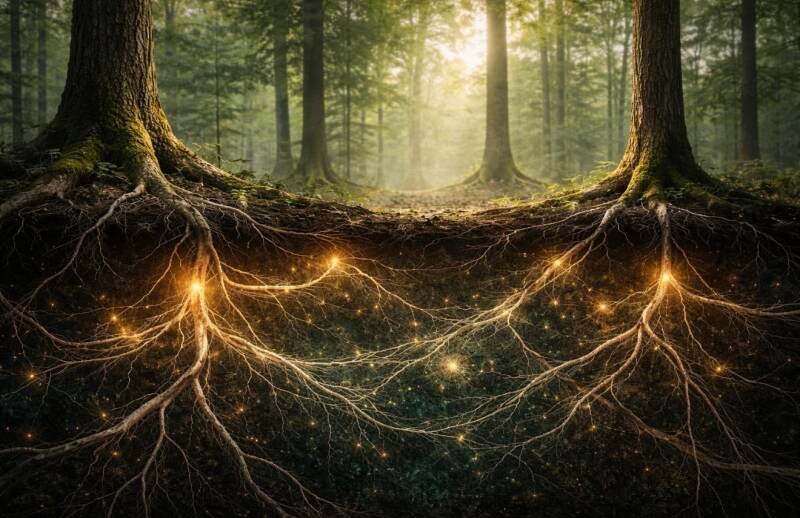
Forests survive because their roots share nutrients beneath the soil.
They are not weaker because they are connected.
They are stronger because they are.
Perhaps humans are no different.
Maybe healing isn't convincing your nervous system that it no longer needs anyone.
Maybe healing is offering it enough experiences of safe, genuine connection that it slowly realizes it no longer has to prepare for abandonment.
---
Home
Perhaps this is why certain places feel different.
Not because they solve your problems.
Not because they tell you exactly what to do.
But because something inside you quietly stops keeping watch.
Your breathing slows.
Your shoulders soften.
Your thoughts become a little less loud.
Your body remembers something your mind had forgotten.
That belonging has never been something you were supposed to earn.
It has always been something you were built for.
Maybe that's what home has always been.
Not a building.
Not a destination.
But the place where your nervous system finally receives an ancient message it has been waiting to hear all along.
You're here.
You're safe.
You don't have to survive this alone anymore.
Add comment
Comments