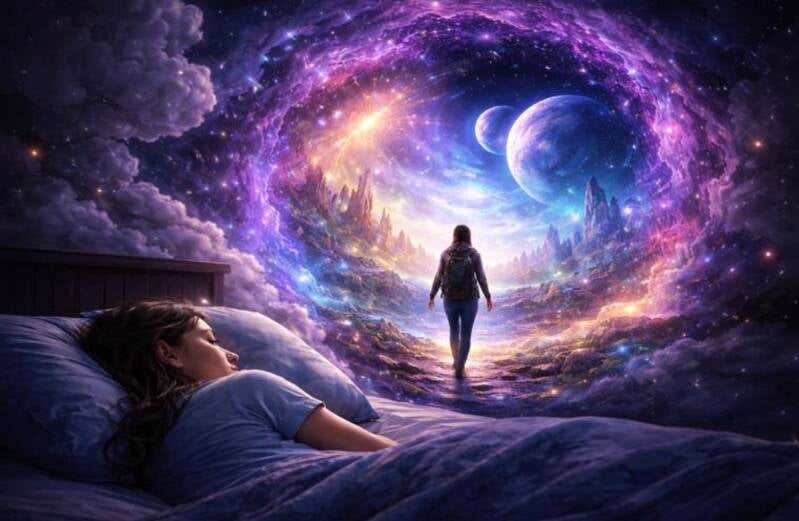
Why Dreams Feel So Real: The Neuroscience and Mystery of the Sleeping Mind
Every night you disappear.
Not metaphorically.
Literally.
The world you spent the entire day navigating fades into darkness, and without lifting a finger, your mind begins constructing another one.
Landscapes emerge from nowhere.
People appear who haven't crossed your mind in years.
Conversations unfold with complete emotional depth.
There are streets to walk, oceans to cross, buildings you've never seen before, and sometimes entire civilizations that seem to have existed long before you arrived.
While you're inside the dream, almost none of it feels unusual.
You don't stop to ask where the city came from.
You don't question why your childhood home suddenly overlooks the ocean.
You don't wonder how someone who passed away years ago is sitting beside you, smiling as though no time has passed at all.
Your mind accepts it completely.
Only when you wake do you realize that the entire reality has dissolved.
Which raises a fascinating question.
If your brain can construct one world that feels completely real while you're asleep...
How certain can any of us be about the nature of reality itself?
Not because dreams prove that waking life is an illusion.
They don't.
But because they reveal just how convincing consciousness can be.
Your Brain Is Building More Than Images
Modern neuroscience has learned an extraordinary amount about dreaming, even if many questions remain unanswered.
Most vivid dreams occur during REM (Rapid Eye Movement) sleep, when the brain becomes remarkably active. In many ways, brain activity during REM resembles wakefulness more than deep sleep.
Visual regions of the brain become highly active.
Areas involved in emotion, particularly the amygdala, are also working intensely, which may explain why dreams often feel emotionally amplified.
Meanwhile, the prefrontal cortex—the part of the brain responsible for logic, critical thinking, and reality checking—is significantly less active.
This creates an unusual combination.
Your imagination is operating at full capacity.
Your emotions are fully engaged.
But the part of your mind that usually asks, "Does this make sense?" has temporarily stepped into the background.
That is why you rarely question impossible events inside a dream.
Flying feels normal.
Talking animals seem perfectly reasonable.
Entire timelines can shift in an instant without raising suspicion.
Your brain isn't trying to deceive you.
It's simply creating the most coherent story it can from memories, emotions, sensory fragments, and imagination.
Dreams Borrow From Memory but Create Something New
One of the most fascinating discoveries is that dreams aren't random collections of images.
The brain appears to weave together pieces of experience from different periods of your life.
A stranger may carry the smile of an old friend.
A building might combine three places you've visited across different decades.
An emotion you've been avoiding during the day may become the central storyline at night.
Researchers believe dreaming plays an important role in memory consolidation, emotional processing, and integrating new experiences with existing knowledge.
In other words...
Your sleeping brain isn't switched off.
It's reorganizing.
Sorting.
Connecting.
Experimenting.
Almost like an artist taking thousands of scattered puzzle pieces and arranging them into something you've never consciously seen before.
Why Some Dreams Stay With Us
Most dreams disappear within minutes of waking.
Others remain vivid for years.
Perhaps because they weren't simply stories.
They were experiences.
Some dreams carry emotions that seem deeper than ordinary memory.
Some offer unexpected clarity.
Others feel profoundly symbolic, leaving us with questions rather than answers.
Science can explain many aspects of dreaming, but it cannot yet explain why certain dreams continue to shape us long after they end.
Anyone who has dreamed of a loved one after they passed away understands this.
Whether those dreams arise entirely from memory or represent something more is a question each person must answer for themselves.
The experience itself is real.
The meaning belongs to the dreamer.
The Beautiful Humility of Not Knowing
Our culture often treats uncertainty as something to eliminate.
We want definitive answers.
Proof.
Certainty.
But dreams quietly remind us that consciousness is still one of the greatest mysteries science has ever encountered.
Despite extraordinary advances in neuroscience, researchers still cannot fully explain why subjective experience exists at all.
Why awareness feels like something from the inside.
Or why consciousness can generate worlds so convincing that we inhabit them without question.
That isn't a weakness of science.
It's an invitation to curiosity.
Perhaps That Is the Real Gift of Dreams
Maybe dreams aren't here to tell the future.
Maybe they aren't hidden messages waiting to be decoded.
Maybe they don't prove anything supernatural.
Or perhaps, sometimes, they do.
The honest answer is that we don't know.
And there is something deeply beautiful about allowing that mystery to remain open.
Every night your mind demonstrates a remarkable truth.
Reality, as you experience it, is far richer than you often realize.
It is shaped by perception.
By memory.
By emotion.
By attention.
By consciousness itself.
Dreams remind us that our experience of the world is never just about what is happening "out there."
It is also about the astonishing universe unfolding within us.
So perhaps the question isn't whether dreams are another reality.
Perhaps the better question is this:
If your mind is capable of creating worlds while you sleep...
What else might it be capable of while you're awake?

Add comment
Comments