Beyond Healing: How to Stop Letting Your Past Decide Who You Become
A lot of healing begins with a declaration.
Never again.
I will never let someone treat me like that again.
I will never become my mother.
I will never become my father.
I will never depend on another person for my happiness.
I will never be powerless again.
I will never be poor again.
I will never abandon myself for someone else again.
And sometimes, never again is sacred.
Sometimes it is the first sound a person makes when they finally realize they are allowed to protect themselves.
It can build boundaries where there were none. It can create movement after years of paralysis. It can pull someone out of relationships, families, patterns and identities that were slowly consuming them.
There is nothing wrong with moving away from the fire.
But eventually, we might need to ask ourselves something uncomfortable:
Who is choosing the direction?
Because you can spend your entire life running away from your past and call it healing.
But if your past is still determining which direction you walk, it isn't entirely behind you.
You may be walking away from the fire.
But the fire is still telling you which direction to walk.
When survival becomes an identity
Human beings are remarkably adaptive.
When something hurts us, we learn.
We notice what preceded the pain. We develop strategies intended to prevent its return. We become more vigilant around certain people, situations, emotions or experiences.
Some of those adaptations are enormously useful.
The problem isn't that we adapted.
The question is whether an adaptation that once protected us has quietly become the architecture of our identity.
Maybe you grew up watching someone surrender themselves inside relationships, so you became fiercely independent.
Maybe money was unpredictable, so you built your entire life around financial security.
Maybe vulnerability was punished, so you became extraordinarily self-sufficient.
Maybe someone controlled you, so now nobody gets to tell you what to do.
Maybe chaos defined your childhood, so you need everything in adulthood to remain perfectly controlled.
From the outside, some of these things may even look like strengths.
And they may genuinely be strengths.
But strength and freedom aren't always the same thing.
Because there is an uncomfortable question underneath all of this:
If your entire personality is built around never becoming the people who hurt you… the people who hurt you are still building your personality.
There it is.
The worded face punch.
Because if my identity requires you as its opposition, you are still participating in its construction.
If I need to know who you were in order to know who I must never become, you remain one of the reference points by which I locate myself.
You may no longer be holding the pen.
But somehow, you're still standing over my shoulder.
Rebellion isn't always freedom
There is a strange relationship between obedience and rebellion.
They look like opposites.
But sometimes they're simply facing different directions.
One person says:
I must become exactly like my father.
Another says:
I must become nothing like my father.
The second sounds considerably more liberated.
But both identities are still organized around Dad.
He's still holding the blueprint.
Which leads to another uncomfortable possibility:
Rebellion is not always freedom. Sometimes rebellion is obedience facing the opposite direction.
Real freedom begins when the reference point itself becomes unnecessary.
Not:
What would they do? I'll do the opposite.
But:
What is actually mine?
What do I value?
What kind of person do I want to be?
What qualities feel true when nobody else is standing in the room?
That's a very different kind of creation.
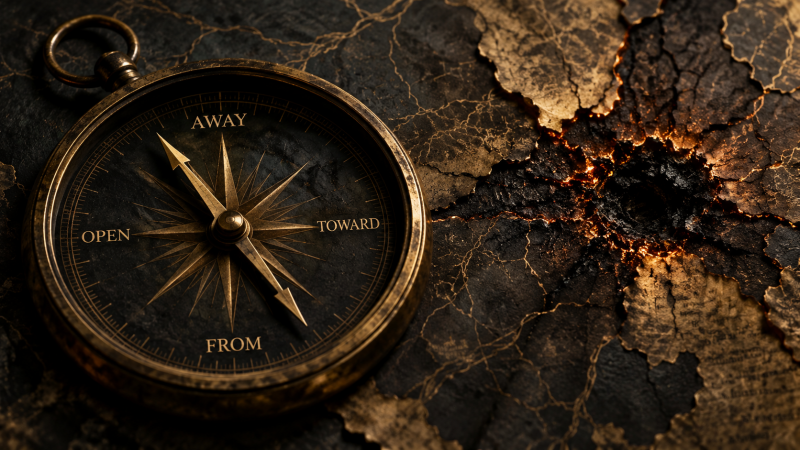
Away from. Open to. Toward. From.
I've been thinking about four different orientations from which we can move through life.
Away from.
Open to.
Toward.
And finally:
From.
Away from
Away-from living is reactive.
Something happened, it hurt, and we organize ourselves around preventing it from happening again.
I don't want that.
I won't experience that again.
I refuse to become that.
This isn't weakness.
Often it's survival.
And sometimes away is exactly the direction we need to travel.
But it remains a life informed largely by what has already happened.
The past says fire.
We walk the other way.
Open to
Eventually, we may reach something closer to neutrality.
I don't know what's going to happen. Let's see.
We aren't necessarily running anymore.
We're allowing.
There's less resistance, less certainty, less insistence that life unfold according to a particular script.
That's an enormous shift.
But there is another movement available.
Toward
We begin orienting ourselves toward possibility.
Maybe something beautiful happens.
Maybe this works.
Maybe I meet someone wonderful.
Maybe the thing I'm creating succeeds.
Maybe the next chapter is better than anything I could currently imagine.
Instead of expecting the worst, we begin allowing ourselves to anticipate something good.
Fear becomes excitement.
And those two emotions are fascinating companions.
Fear imagines a future and asks:
What if everything goes wrong?
Excitement imagines a future and asks:
What if everything goes right?
Worst-case scenario.
Best-case scenario.
Both are future-based propositions about something we ultimately cannot know.
Excitement may be considerably more enjoyable.
But we're still looking toward tomorrow for instructions about how to feel today.
And that's where I think another possibility appears.
From
Living from doesn't require us to predict what happens.
It asks:
What do I want to bring to whatever happens?
Love.
Curiosity.
Courage.
Freedom.
Play.
Compassion.
Wonder.
Integrity.
Peace.
Suddenly these qualities aren't rewards waiting for us at the end of successful circumstances.
They become materials.
We make things with them.
Stop making your soul qualities destinations
So much of life is organized around an unconscious bargain:
When this happens, then I can feel that.
When I have enough money, I'll feel free.
When I find my person, I'll feel loved.
When my life settles down, I'll feel peaceful.
When I finally heal, I'll feel whole.
When I know what I'm doing, I'll feel confident.
We place freedom, love, peace, wholeness and confidence at the finish line.
Then we spend years trying to build circumstances that will grant us permission to experience them.
But what happens if we reverse the equation?
Instead of:
How do I create a life where I can finally feel free?
Ask:
What would freedom do today?
What would love create here?
What would courage say?
What would curiosity investigate?
What would compassion make room for?
What would play choose?
The quality becomes a verb.
You stop trying to get somewhere where you'll finally be allowed to experience yourself.
You begin creating from yourself.
Healing eventually needs a new compass
There is nothing shameful about initially building a life around what you survived.
The nervous system learns through experience.
Pain teaches.
Survival adapts.
And sometimes anger, defiance and never fucking again contain exactly enough energy to get us out of somewhere we desperately need to leave.
But perhaps there comes a point when healing itself needs to evolve.
Because healing that forever requires the wound as its reference point remains, in some way, in relationship with the wound.
Eventually the question changes.
Not:
What am I trying to get away from?
Not even:
What am I trying to get?
But:
What am I here to express?
And perhaps one of the most revealing questions we can ask ourselves is this:
If the thing you're running from disappeared from your internal map entirely… would you still be running in this direction?
Would you still want this career?
Would you still define success this way?
Would you still need this much independence?
Would you still choose these relationships?
Would you still need to prove this?
Would you still be trying so hard to become this version of yourself?
There doesn't need to be an immediate answer.
The question itself may be enough.
Because sometimes we discover that underneath all our running, achieving, protecting and becoming is a person we've barely had the opportunity to meet.
The person who exists when there is finally nothing left to rebel against.
What do you want to live from?
Maybe the deepest form of creation isn't manifesting the future you want.
Maybe it's becoming less dependent on the future altogether.
Not living to escape what was.
Not waiting to see what will be.
Not bargaining with life for what you hope comes next.
But asking:
What do I want to live from?
Love.
Curiosity.
Courage.
Beauty.
Play.
Freedom.
Compassion.
Wonder.
And then letting those things become verbs.
Because I can live from love and still have my heart broken.
I can live from courage and still be afraid.
I can live from curiosity and discover something I didn't want to know.
I can live from freedom and encounter circumstances I cannot control.
I can live from joy knowing grief will visit me again.
These qualities aren't promises about what life will do.
They're declarations about what I want to bring to life.
And perhaps that's freedom.
Not finally creating circumstances that guarantee everything will be okay.
Not becoming the perfect opposite of everyone who ever hurt us.
Not outrunning our history so completely that it can never catch us.
But reaching a place where we can finally say:
I don't need to know what happens next in order to know who I want to be when it does.
The past no longer needs to push.
The future no longer needs to pull.
And for perhaps the first time, the direction comes from within.
Add comment
Comments