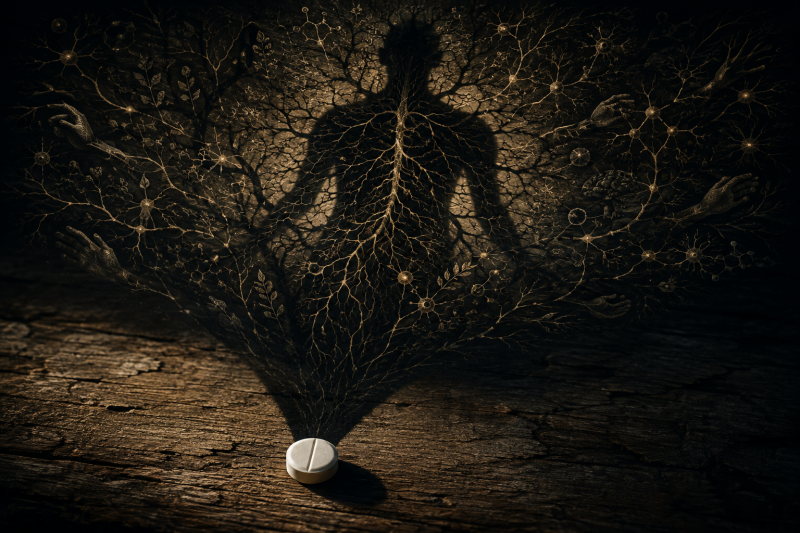
There is a phrase we use when we want to explain away an improvement we don’t entirely trust.
“It was probably just the placebo effect.”
Just...
As though nothing happened.
As though the body was tricked into imagining an improvement that wasn’t really there.
As though placebo is the absence of medicine and therefore the absence of anything worth investigating.
But the longer I sit with placebo research, the stranger that word just begins to sound.
Because sometimes something does happen.
Pain changes.
Symptoms change.
The brain recruits systems involved in pain relief, reward, expectation and regulation.
The treatment may contain no active pharmaceutical ingredient.
But the person receiving it is anything but inactive.
And perhaps we have been so busy asking what wasn’t inside the pill that we forgot to ask what was happening inside the person.
The Strange Case of the Pill You Know Is Fake
The traditional explanation for placebo effects seems relatively straightforward.
Someone believes they are receiving medicine.
They expect to feel better.
That expectation influences their experience.
Interesting, certainly—but not terribly mysterious.
Except researchers eventually did something peculiar.
They told people the truth.
In studies of what are known as open-label placebos, participants have knowingly taken inert treatments. They are explicitly told that the pills contain no active medication.
No deception.
No secret pharmaceutical ingredient.
And yet randomized studies involving conditions such as irritable bowel syndrome, chronic low-back pain and cancer-related fatigue have found symptom improvements in some participants.
That does not mean open-label placebos work for every person or every condition.
It certainly does not mean belief can cure every disease.
And it does not mean we should replace effective medical treatment with sugar pills.
It means something far more interesting:
Knowing consciously that a treatment is inert does not necessarily make the entire treatment experience inert.
Because a pill is never experienced in a vacuum.
There is a bottle.
There is a routine.
There is an explanation.
There may be a clinician.
There is attention being paid to the body.
There is the repeated act of participating in something organized around the possibility of improvement.
And suddenly the question changes.
Perhaps expectation isn't simply:
I believe there is medicine inside this pill.
Perhaps expectation can exist somewhere beneath explicit belief.
Perhaps some part of the organism recognizes:
We are doing the thing we do when healing is possible.
The Body Reads More Than Ingredients
We tend to imagine treatment as though the body were a lock and medicine were a key.
Insert the correct molecule.
Produce the corresponding biological effect.
And obviously, pharmacology matters enormously.
Drugs change physiology.
Surgery changes physiology.
Medical intervention saves lives every day.
But humans are not chemistry sets sealed away from experience.
We are organisms constantly interpreting our surroundings.
Threat means something to the nervous system.
Safety means something.
Attention means something.
Relationship means something.
Previous experience means something.
Expectation means something.
Ritual means something.
And sometimes those meanings participate in physiology.
Research into placebo analgesia, for example, has implicated endogenous opioid systems—the body's own pain-modulating chemistry. Other placebo responses have involved dopamine and other neurobiological pathways.
Which means saying the body responds to “context rather than chemistry” isn't quite right.
Because when the body responds to context,
the response itself can become chemistry.
That may be the part I find most extraordinary.
Meaning can acquire a molecular footprint.
“Just Placebo”
Imagine someone experiences less pain after receiving an inactive treatment.
We discover that the pill contained nothing pharmacologically capable of producing that relief.
And we say:
It was just placebo.
But what exactly have we dismissed?
The pill was inert.
The person wasn't.
Their brain was still predicting.
Their nervous system was still interpreting.
Their previous experiences were still informing the present one.
Their body was still responding to cues of care, treatment, possibility and expectation.
None of this makes the symptom imaginary.
And none of it means every placebo response represents objective healing of an underlying disease. Placebo effects can influence some symptoms much more readily than others, and symptom relief is not the same thing as curing pathology.
That distinction matters.
But so does this one:
An experience can originate partly through context and still be biologically real.
Perhaps “placebo” was never synonymous with nothing.
Perhaps it was the name we gave to everything happening around the thing we knew how to measure.
The Ritual of Getting Better
There is something else hiding inside this research that I find deeply human.
Healing has almost always involved ritual.
Long before randomized controlled trials and pharmaceutical laboratories, humans gathered around illness.
Someone prepared something.
Someone administered it.
Someone touched the body.
Someone listened.
Someone said:
Do this.
Take this.
Rest here.
Come back tomorrow.
Some of those practices undoubtedly contained effective medicines we simply hadn't yet understood.
Some did nothing.
Some caused harm.
And some may have carried another ingredient that is considerably harder to isolate:
the experience of being cared for while participating in one's own recovery.
Modern medicine had excellent reasons to separate treatment from context.
If we want to know whether a drug works, we need to determine what the molecule itself is doing.
Placebo-controlled trials help us do precisely that.
But perhaps the very thing science needed to control for in order to understand medication also revealed something worth understanding in its own right.
Context is not empty space.
The encounter surrounding treatment is itself an experience being interpreted by a living nervous system.
This Is Not “Think Yourself Well”
There is a dangerous place we could take this idea, and I don't want to go there.
Because the moment we discover that expectation and context can influence physiology, it becomes tempting to turn that observation into:
Your thoughts create your illness.
Or:
If you believed strongly enough, you could heal yourself.
No.
That transforms an intriguing property of human biology into blame.
Bodies become sick for countless reasons beyond conscious control.
People cannot positively think their way out of every disease.
A person whose treatment isn't working has not failed to believe correctly.
And sometimes what the body needs really is something from outside itself:
Antibiotics.
Insulin.
Chemotherapy.
Surgery.
Medication.
Skilled medical care.
The existence of placebo effects does not diminish any of that.
It simply tells us chemistry may not be the only information entering the system.
And perhaps that is more interesting anyway.
This isn't mind over matter.
It may be another reminder that the boundary we drew between mind and matter was never as clean as we imagined.
The Prescription We Cannot See
Maybe this is why the open-label placebo studies fascinate me so much.
A person can hold two pieces of information simultaneously.
Their conscious mind can know:
This pill contains no medicine.
And their organism can still participate in an experience organized around:
Something is being done.
Someone is paying attention.
I am taking part.
Relief may be possible.
We don't yet understand everything occurring inside that experience.
And I think there is something beautiful about resisting the temptation to pretend we do.
Because wonder does not require certainty.
Sometimes the evidence is most interesting precisely where it complicates the story we thought we understood.
The placebo effect doesn't prove that consciousness can cure everything.
It doesn't prove ancient traditions understood neuroscience thousands of years before neuroscience existed.
It doesn't make medicine unnecessary.
But it does leave us with a remarkable possibility:
What something means to us can sometimes become part of what our biology does with it.
So perhaps the next time we hear that something was “just placebo,” we might become a little more curious about the word just.
Because the pill may contain nothing.
The ritual does not.
The relationship does not.
The expectation does not.
The nervous system does not.
The person never does.
Maybe the placebo effect was never the embarrassing part of the experiment.
Maybe it was the finding.
And perhaps the question waiting behind it has been there all along:
What if healing isn't only about what enters the body—but also about what the body understands is happening?
Add comment
Comments