The Unwritten Part: Alan Watts, Uncertainty, and What Makes Life Feel Alive
Alan Watts once offered a thought experiment that has stayed with me.
Imagine that every night when you fell asleep, you could dream any dream you wanted.
Not just for a few hours. You could experience an entire lifetime within it.
And because you were creating the dream, you could control everything.
At first, you'd probably give yourself everything you've ever wanted.
You'd fall impossibly in love.
You'd travel everywhere.
You'd experience every pleasure.
You'd succeed spectacularly.
You'd live adventures reality could never provide.
Nothing would go wrong unless you wanted it to.
And for a while, that might feel like paradise.
But Watts imagined something interesting happening eventually.
You'd get bored.
Not because pleasure had somehow become bad, but because nothing could surprise you anymore.
So eventually, you might introduce something unexpected.
Just a little uncertainty.
Something you hadn't completely predetermined.
And then perhaps you'd become more adventurous.
You'd surrender a little more control.
Allow more mystery.
More possibility.
More risk.
Until eventually, Watts suggested, you might become adventurous enough to dream a life in which you had completely forgotten you were dreaming.
A life where you didn't know what happened next.
Perhaps even—
the life you're living right now.
The Part I Would Change
There are versions of this idea circulating that take Watts's thought experiment one step further.
They suggest that every difficult thing we've experienced was deliberately chosen before we arrived here.
Every loss.
Every betrayal.
Every illness.
Every trauma.
Every heartbreak.
They're simply plot twists we requested before falling asleep.
I understand why that interpretation can feel comforting.
But I don't think we need it.
Because there is an enormous difference between saying:
“You chose everything that happened to you.”
and asking:
“What if uncertainty itself is necessary for the experience of being alive?”
The first makes a metaphysical claim none of us can prove.
And in the face of profound suffering, it can become unintentionally cruel.
The second asks us to consider something much more immediate.
What would life actually feel like if nothing were unknown?
Imagine Knowing Everything
Imagine knowing exactly how the rest of your life will unfold.
Every person you're going to meet.
Every friendship that will fade.
Every person who will stay.
Every relationship that will end.
Every opportunity you'll receive.
Every mistake you'll make.
Every illness you'll experience.
Every dream that will come true.
Every dream that won't.
You know exactly where you'll be ten years from now.
Twenty.
Thirty.
You even know the final page.
At first, that level of certainty might sound comforting.
No anxiety.
No wondering.
No lying awake at night trying to determine whether you're making the right decision.
But there would also be something else missing.
Possibility.
Nothing could genuinely surprise you.
Nothing could be discovered.
Nothing could unfold.
And perhaps most importantly—
you could never truly wonder.
Curiosity Needs the Unknown
I've spent a lot of time thinking about curiosity.
We tend to treat curiosity as something that helps us navigate uncertainty.
We don't know, so we become curious.
But Watts's thought experiment made me wonder whether the relationship runs deeper than that.
Curiosity requires uncertainty.
You cannot genuinely wonder about something you've already decided.
You cannot discover something you already know.
You cannot be surprised by an ending you've already seen.
Which means the unknown isn't simply something curiosity helps us tolerate.
The unknown is what makes curiosity possible.
And suddenly uncertainty begins to look different.
Not comfortable.
Not always welcome.
But necessary.
A story requires an unwritten page.
A mystery requires something hidden.
Discovery requires something not yet found.
Courage requires an outcome that isn't guaranteed.
Hope requires a future we haven't seen.
And becoming requires a version of ourselves we haven't met yet.
Maybe uncertainty isn't simply the price we pay for being alive.
Maybe uncertainty is what gives existence a pulse.
Our Strange Hunger for Certainty
Human beings don't particularly like uncertainty.
We want to know.
Is this relationship going to work?
Am I making the right decision?
Will my family be okay?
Will my body remain healthy?
Will this dream succeed?
Am I on the right path?
What happens after death?
What does all of this mean?
And beneath many of those questions is another one:
Am I safe?
Certainty feels like safety because knowing what happens next seems as though it would allow us to prepare for it.
So we make predictions.
Construct narratives.
Search for signs.
Create philosophies.
Build religions.
Study psychology.
Read horoscopes.
Consult science.
Ask friends.
Ask strangers.
Ask Google at two in the morning.
We are meaning-making creatures trying desperately to illuminate the next few feet of road.
And there is nothing inherently wrong with that.
Maps are useful.
Knowledge matters.
Preparation matters.
Wisdom matters.
But eventually every map reaches its edge.
And there remains a part of existence that simply refuses to tell us what happens next.
Perhaps that isn't a design failure.
Perhaps that is where life begins.
Awakening Inside the Dream
This is where Watts's dream becomes most beautiful to me.
Because I don't think its deepest invitation is:
None of this is real, so none of it matters.
Quite the opposite.
Maybe it's:
I don't ultimately know what any of this is, so I am going to be completely here for it.
I will love people even though I cannot guarantee how long they will remain.
I will begin things without knowing whether they will succeed.
I will allow myself to change my mind when reality shows me something I hadn't considered.
I will grieve when something precious disappears.
I will laugh when something is absurd.
I will follow questions whose answers I cannot yet see.
I will stand at the edge of the map without demanding that someone draw the rest before I take another step.
Because perhaps awakening isn't waking up from the dream.
Perhaps it's waking up inside it.
The Cosmic Joke
Watts loved playing with the strange possibility that the separation we experience between ourselves and existence isn't quite what it appears to be.
That perhaps the experiencer and the experience belong to the same larger process.
And this creates one of the great spiritual paradoxes.
We spend our lives searching.
For purpose.
For belonging.
For ourselves.
For God.
For enlightenment.
For the person we're supposed to become.
For the moment when everything finally clicks into place and we can say:
There. Now I understand.
Meanwhile, the thing doing all of that searching may already belong completely to the thing it is searching for.
Maybe that's the joke.
We keep trying to arrive inside a life we're already standing in.
The Unwritten Part
I don't know whether life is literally a dream.
I don't know whether consciousness exists beyond the body.
I don't know whether there is some larger intelligence experiencing itself through us.
I don't know whether Watts was pointing toward a metaphysical truth or simply giving us an extraordinarily beautiful way of thinking about existence.
And perhaps, appropriately—
I don't need to know.
Because the uncertainty is part of what makes the question worth asking.
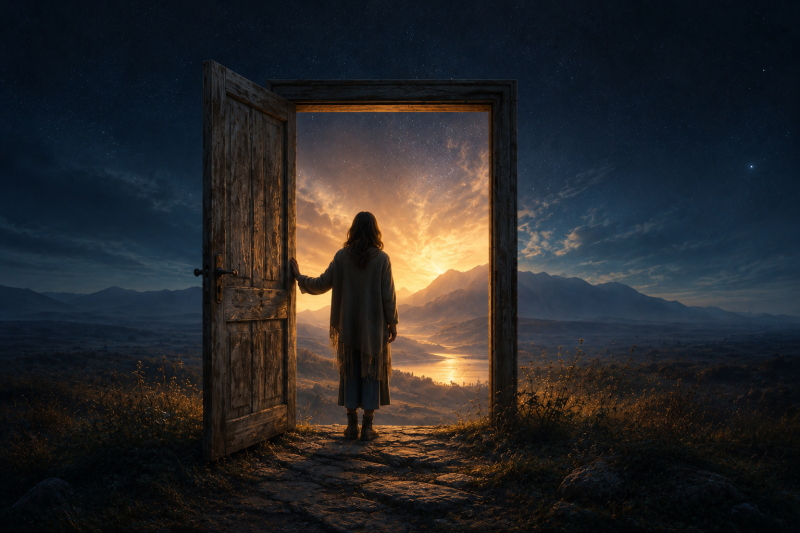
There will always be an unwritten part.
A section of road beyond the reach of the headlights.
A page we haven't turned.
A version of ourselves we haven't met.
We can spend our lives standing at that boundary demanding certainty before we continue.
Or perhaps we can occasionally stand there with something else.
Curiosity.
Not because everything that waits for us will be easy.
Not because suffering secretly doesn't hurt.
Not because every terrible thing was somehow chosen.
But because even after everything we've already experienced, existence still contains something astonishing:
something we haven't seen yet.
Maybe awakening isn't finally discovering what the dream means.
Maybe it's realizing you don't have to know what happens next to be fully awake inside it.
Maybe the great invitation isn't:
Figure it all out.
Maybe it's simply:
Pay attention.
Add comment
Comments