
There is an old story about a healer who could heal almost anyone.
Except himself.
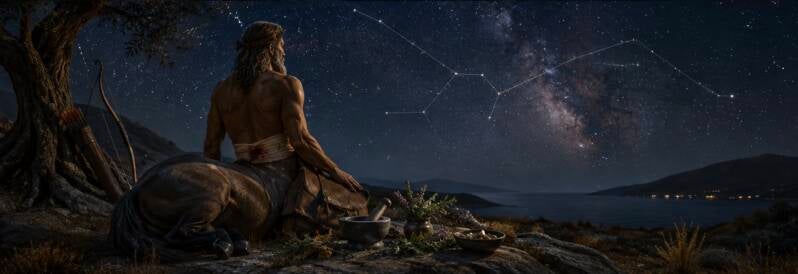
His name was Chiron.
In Greek mythology, Chiron was a centaur, but he was often portrayed very differently from the wild and unruly centaurs found elsewhere in the myths.
Chiron was wise.
Gentle.
A teacher.
A healer.
He became associated with medicine, herbs, music, prophecy and the education of heroes. Among those traditionally connected to his teaching were figures such as Achilles and Asclepius, who would himself become mythology's great physician.
Chiron knew how to tend wounds.
And then he received one he could not tend.
According to one version of the myth, Chiron was accidentally struck by an arrow belonging to Heracles. The arrow had been poisoned with the venom of the Hydra, making the wound incurable.
For a mortal, it would have meant death.
But Chiron was immortal.
And so mythology created an almost unbearable paradox:
The healer could not heal himself.
He possessed extraordinary knowledge of suffering while remaining unable to escape his own.
Centuries later, that image still speaks to something profoundly human.
We now sometimes call it:
the wounded healer.
The Strange Wisdom of a Wound
There are things we can learn about pain from books.
We can study grief.
We can learn the psychology of trauma.
We can understand attachment, addiction, loneliness, shame, fear and loss intellectually.
And that knowledge matters.
But there is another kind of knowing.
The knowing that comes from having lived somewhere.
Someone can explain grief beautifully without ever having lost the person they cannot imagine living without.
And then one day they do.
The definition hasn't changed.
But the language has.
Suddenly they understand why someone keeps reaching for a phone to call a person who is no longer alive.
Why a smell can collapse ten years into ten seconds.
Why laughter can coexist with devastation.
Why grief can disappear for an afternoon and then return because you saw someone's shoes by a doorway.
None of that makes lived experience superior to knowledge.
It makes it different.
There are landscapes of the human experience that look different from inside them.
And perhaps this is what makes Chiron such a powerful archetype.
He didn't merely know about wounds.
He knew what it was to carry one.
But Pain Does Not Automatically Make Us Wise
There is something important we need to be careful about here.
We sometimes romanticize suffering.
We look backward at someone's extraordinary compassion and say:
Everything happened for a reason.
You needed that wound.
It made you who you are.
Perhaps.
But I think there is another possibility that honours the transformation without making suffering sacred.
Maybe you never needed to be hurt.
Maybe what happened to you wasn't secretly assigned by the universe so you could become useful later.
Maybe some things are simply devastating.
Unfair.
Unnecessary.
And still—
human beings possess this extraordinary ability to take what happened to them and decide what happens through them.
Because suffering itself does not create wisdom.
Pain can make us compassionate.
It can also make us cruel.
Pain can open us.
It can also close us.
Pain can teach us to recognize suffering in another person.
It can also convince us that because nobody came for us, nobody deserves to be rescued.
The wound is not the wisdom.
What we do in relationship with the wound can become wisdom.
The questioning.
The grieving.
The reckoning.
The boundaries.
The forgiveness when forgiveness is possible.
The refusal to pass forward what was handed backward.
The willingness to look at something painful without making it the entire definition of who we are.
Maybe that is where the wounded healer is actually born.
Not at the moment of wounding.
But somewhere in what happens afterward.
I've Lived Somewhere Pain Lives
There is a particular kind of comfort in meeting someone who doesn't need your suffering translated.
Someone who recognizes the terrain.
They don't necessarily know exactly what you're experiencing.
Nobody does.
But something in them understands the geography.
They don't rush toward the usual sentences.
Everything happens for a reason.
At least...
You should...
Have you tried...
Instead, perhaps they simply pull up a chair.
Because they've lived somewhere pain lives.
And they remember what it was like when someone tried to turn their unbearable experience into a lesson before they had even finished experiencing it.
That kind of presence cannot always fix anything.
But sometimes it does something just as important.
It makes suffering less lonely.
Perhaps the wounded healer isn't someone standing on the other side of pain shouting instructions back toward us.
Perhaps they are someone willing to walk into the darkness carrying a lantern.
Not saying:
I know exactly where you need to go.
But:
I recognize some of this terrain.
I'll walk beside you.
You Do Not Have to Be Finished
There is another assumption hiding inside our modern language of healing.
That eventually we will become healed.
Finished.
Resolved.
As though healing is a destination we reach where every wound has closed, every trigger has disappeared, every grief has been integrated and every frightened version of ourselves has finally stopped knocking on the door.
And only then will we be qualified to help anyone else.
But human beings rarely work that way.
We sit beside another person's grief while carrying grief of our own.
We teach boundaries while still discovering ours.
We help someone recognize their worth on days when we struggle to remember our own.
We offer directions toward home while occasionally realizing we've wandered away from ourselves again.
That doesn't necessarily make us hypocrites.
It makes us unfinished human beings helping other unfinished human beings.
Maybe you don't need to ask:
Have I healed every wound?
Maybe a better question is:
Has what I've lived taught me how to meet another person's wound with greater tenderness?
The Shadow of the Wounded Healer
But every archetype has a shadow.
And this one has an especially seductive one.
Because eventually we can become so identified with being the person who survived that we forget we are allowed to become something else.
The wound becomes our credential.
Our usefulness.
Our identity.
People come to us because we understand suffering.
So somewhere quietly underneath everything, we may begin to wonder:
Who am I if I no longer suffer?
Will I still understand people?
Will I still have something to offer?
Will I still be needed?
This is where the wounded healer can become trapped inside their own mythology.
Because your wound may have introduced you to a part of humanity you might otherwise never have encountered.
But you do not owe that wound permanent residency.
You do not have to keep bleeding to prove you understand blood.
You are allowed to heal beyond the version of yourself that first learned the lesson.
You are allowed to become joyful without betraying the person who suffered.
You are allowed to stop organizing your identity around what happened to you.
You are allowed to leave the battlefield.
The wisdom can come with you.
The Wound Is Not the Gift
Maybe this is the distinction I keep returning to.
Your wound is not necessarily the gift.
Perhaps the compassion you developed while tending it is.
The ability to recognize pain before someone has found words for it.
The patience to sit beside what cannot immediately be fixed.
The humility to understand that healing rarely moves in straight lines.
The ability to say:
I don't know exactly what this is like for you.
But I'm not afraid of being here with you.
Those things may have grown around the wound.
Like roots growing around stone.
The stone did not need to be there.
But the roots learned how to grow anyway.
And perhaps that is one of the most beautiful things about being human.
We are capable of making meaning without pretending everything that happened to us was meaningful.
We can transform suffering without worshipping it.
We can honour what pain taught us without believing pain was our teacher by divine appointment.
We can carry wisdom forward without carrying the wound forever.
The Healer Who Still Hurt
Thousands of years later, Chiron remains with us.
A healer who hurt.
A teacher who could not solve everything.
A figure whose wisdom and suffering existed in the same body.
Maybe that is why his story still feels so familiar.
Because somewhere along the way, many of us were taught that we needed to become completely healed before we could become helpful.
Completely certain before we could teach.
Completely whole before we could love.
Completely fearless before we could guide someone through darkness.
But perhaps Chiron whispers something else across the centuries.
You can still be learning and share something you've learned.
You can still carry grief and sit beside grief.
You can still have tender places and offer tenderness.
You can still occasionally lose sight of your own North Star and hold a lantern while someone else searches for theirs.
Your wounds do not automatically make you wise.
And they do not make you broken.
They are simply places where life happened to you.
What grows around them is another story.
And maybe the wounded healer isn't the person who says:
Look how completely I healed.
Maybe it is the person who quietly says:
I've lived somewhere pain lives.
If you ever find yourself there,
I know how to sit beside you.
Add comment
Comments