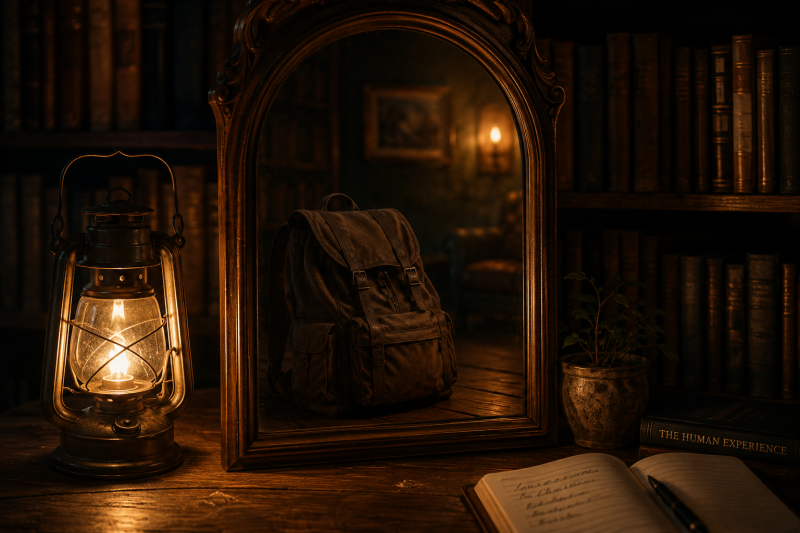
Why Human Beings Numb
The behaviour is rarely the beginning of the story. More often, it’s the final chapter of one we never learned how to tell.
Nobody wakes up one morning hoping to numb their life.
They hope to numb their pain.
Those are two very different things.
Yet we often talk about them as though they’re the same.
We ask,
“Why would someone do this to themselves?”
Perhaps a more compassionate question is,
“What became so painful that not feeling it seemed like the better option?”
That question doesn’t excuse harmful behaviour.
It simply asks us to become curious before we become judgmental.
Sometimes curiosity is where healing quietly begins.
⸻
Pain has an extraordinary ability to reshape the human mind.
Grief that never found a place to land.
A childhood spent learning that emotions weren’t safe.
Trauma that convinced the nervous system the danger never truly ended.
Anxiety that leaves the body permanently braced for something that may never happen.
Shame that slowly becomes part of a person’s identity instead of an emotion they occasionally experience.
No one chooses those things.
But eventually, almost everyone searches for relief from them.
⸻
That relief can take many forms.
Sometimes it’s alcohol.
Sometimes it’s drugs.
Sometimes it’s food.
Sometimes it’s gambling.
Sometimes it’s work.
Sometimes it’s perfectionism.
Sometimes it’s endlessly staying busy.
Sometimes it’s scrolling until two in the morning because silence feels louder than another video.
The behaviour changes.
The longing underneath often doesn’t.
It quietly whispers,
“Please… just let this stop for a little while.”
⸻
One of the greatest misunderstandings about coping is believing that people become attached to a substance.
More often, they become attached to the relief it once promised.
That’s an important distinction.
No one falls in love with a bottle.
Or a pill.
Or a behaviour.
They fall in love with what happened during those first moments.
The racing thoughts became quieter.
The grief became softer.
The shame loosened its grip.
The nervous system finally exhaled.
For a little while…
they could breathe again.
That is what they return to.
Not the substance.
The memory of relief.
⸻
Our brains are remarkable.
Their first priority is not happiness.
It’s survival.
When something helps us survive an unbearable moment, the brain remembers.
Not because it’s trying to sabotage us.
Because it’s trying to protect us.
It quietly files the experience away.
“Remember this.”
“This helped us survive.”
That is how coping strategies become habits.
How habits become patterns.
And sometimes…
how patterns become addictions.
Not because we’re weak.
Because our brains are extraordinarily good at remembering what once reduced suffering.
The tragedy is that what helps us survive one chapter of our lives doesn’t always help us live the next one.
⸻
Healing Isn’t Asking
“Why did I become like this?”
Healing gently asks,
“What was I trying to survive?”
That single shift changes everything.
Because suddenly, we’re no longer looking at a broken person.
We’re looking at a human being whose nervous system adapted to circumstances it was never meant to carry alone.
⸻
This is why shame is such a poor teacher
Shame says,
“Look what you’ve become.”
Curiosity asks,
“What happened that made this feel necessary?”
One closes the door.
The other opens it.
One pushes people further into hiding.
The other creates enough safety for truth to emerge.
⸻
I’ve come to believe that every unhealthy coping strategy begins with something surprisingly human.
Hope.
Not hope that life will fall apart.
Hope that maybe…
just maybe…
this will finally make the pain quiet enough to sleep.
Quiet enough to breathe.
Quiet enough to survive another day.
There is hope hidden inside even our most painful attempts to escape.
It’s simply searching in the wrong place.
⸻
The opposite of numbing isn’t suffering.
It’s feeling safe enough to feel.
That is a very different destination.
Healing doesn’t ask us to white-knuckle our way through pain.
It asks us to slowly build a life where our nervous system no longer believes escape is the only option.
A life where relief comes through connection instead of isolation.
Through understanding instead of shame.
Through being witnessed instead of hiding.
⸻
Perhaps that’s why I no longer believe the most important question is,
“Why are you doing this?”
I think the more courageous question is,
“What hurts so much that this became your way of surviving?”
Because every behaviour tells a story.
Every coping strategy carries a history.
Every attempt to numb reveals something that once felt impossible to carry.
And underneath all of them…
is often the same quiet human longing.
“Please help me find another way to live with this.”
Maybe that’s where healing begins.
Not by judging the way someone survived…
But by helping them discover they no longer have to survive alone.
⸻
Add comment
Comments