The Psychology of Relief
Why human beings reach for anything that promises to make the pain stop.
I don't know any happy, well-adjusted, average person who wakes up one morning and says...
"You know what? I think I'd like to become an alcoholic."
Or addicted to opioids.
Or trapped in compulsive gambling.
Or unable to stop working.
Or scrolling until two in the morning because silence feels louder than another video.
That isn't how most stories begin.
People rarely set out looking for addiction.
More often, they are looking for RELIEF.
Relief from grief.
Relief from trauma.
Relief from anxiety.
Relief from shame.
Relief from loneliness.
Relief from memories that refuse to stay in the past.
Relief from a nervous system that has forgotten what safety feels like.
The behaviour is what we notice.
The longing underneath it is what often goes unseen.
One of the greatest misunderstandings about human behaviour is the belief that people do harmful things because they don't care.
More often, they do them because they care desperately about stopping something that has become unbearable.
That doesn't make every behaviour healthy.
It doesn't remove responsibility.
But it does invite a different question.
Instead of asking,
"What's wrong with this person?"
What if we asked,
"What pain became so overwhelming that this made sense?"
That single shift doesn't excuse the behaviour.
It transforms our understanding of it.
This is why addiction can never be understood by looking only at the substance.
Alcohol is one story.
Prescription medication is another.
Drugs, gambling, food, work, shopping, pornography, perfectionism, endless achievement, compulsive busyness...
The objects are different.
The psychology is often remarkably similar.
Somewhere along the way, something provided relief.
Maybe only for a moment.
Maybe only enough to get through the day.
But when pain becomes greater than our ability to carry it, the human brain naturally begins searching for ways to reduce that pain.
It isn't weakness.
It's adaptation.
The tragedy is that what begins as relief can slowly become another source of suffering.
This is where many conversations stop.
We become so focused on helping people remove the behaviour that we forget to ask what the behaviour was trying to accomplish in the first place.
Imagine trying to pull a life jacket away from someone who believes they're drowning.
Even if the life jacket is damaged...
Even if it can no longer keep them afloat...
The fear underneath is still real.
Healing asks us to understand the fear before we ask someone to let go.
Relief and healing are not the same thing.
Relief helps us escape pain for a while.
Healing changes our relationship with pain.
Relief says,
"I can't feel this anymore."
Healing gently asks,
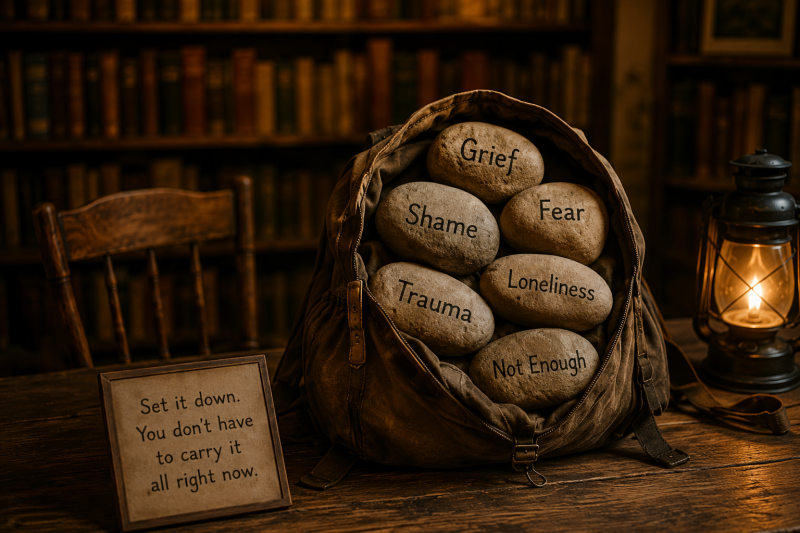
"What if you didn't have to carry it alone?"
That difference changes everything.
Over the years, I've had the privilege of sitting with countless people during some of the hardest moments of their lives.
One thing has become unmistakably clear.
Human beings are rarely as irrational as they first appear.
Our behaviours often make perfect sense once we understand the story our nervous system has been trying to survive.
The person who controls everything may have grown up in chaos.
The person who never slows down may only feel safe when they're productive.
The person who can't stop reaching for relief may have never been shown another way to carry what they're carrying.
When we understand the adaptation, we stop seeing broken people.
We begin seeing human beings.
Perhaps that's why shame so rarely creates lasting change.
Shame whispers,
"There's something wrong with you."
Curiosity asks,
"What happened to you?"
One closes the door.
The other opens it.
I don't believe healing begins the moment someone stops reaching for relief.
I believe healing begins the moment they no longer have to hide why they needed it.
When someone is truly seen...
When their pain no longer has to be translated into a behaviour before another person notices it...
Something remarkable begins to happen.
The nervous system softens.
Hope returns.
And for perhaps the first time in a long time, relief is no longer found in escaping life.
It begins to emerge from being able to live it.
Because underneath every coping strategy...
Every addiction...
Every desperate attempt to make the pain stop...
There is often the same quiet human longing.
"Please help me carry what has become too heavy to hold alone."
And perhaps that is where healing has always begun.
Add comment
Comments