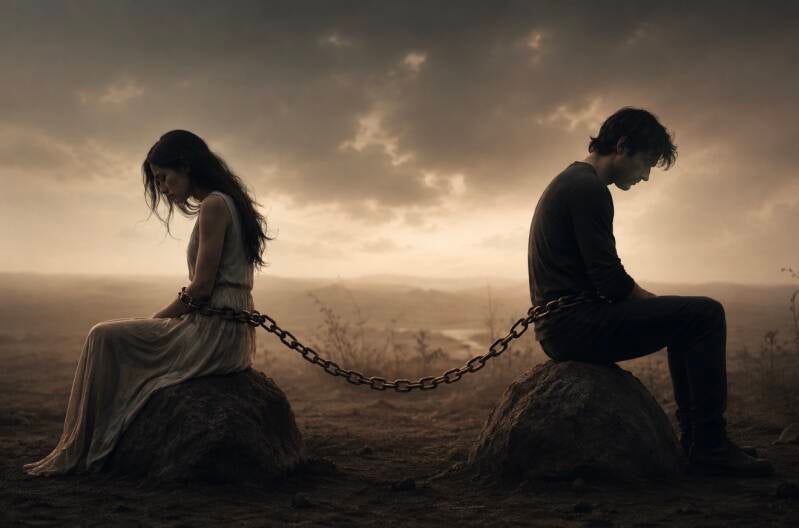
When the Addiction Is Another Person
Recently , I spent almost three hours on the phone with a woman.
Her family wanted her to seek treatment for addiction. Eventually, she agreed to speak with me.
I expected our conversation to revolve around alcohol.
Instead, for nearly three hours, she talked about her husband.
She told me about the infidelity.
The emotional abuse.
The years of hoping things would change.
And over and over again, she asked the same question.
"If he's not willing to get help... why should I?"
That question stayed with me long after we hung up.
Because doing work in addiction and mental health, I've come to realize something profound.
Sometimes the greatest obstacle to healing isn't the substance.
Sometimes it's the relationship.
Not because relationships are inherently unhealthy, but because another human being has quietly become the place where our identity, safety, and hope now live.
This is where codependency begins.
And it may be one of the most misunderstood forms of suffering we experience.
---
The Addiction Nobody Talks About
When someone is struggling with alcohol addiction, people generally know what to do.
Go to treatment.
Attend support meetings.
Seek professional help.
When someone is struggling with anxiety or depression, most people understand that counselling, therapy, or medical support may help.
But what happens when the struggle isn't with a substance?
What happens when the thing you cannot seem to let go of is another person?
Most people don't call that addiction.
They call it love.
Loyalty.
Commitment.
Being a good partner.
Being selfless.
They tell themselves they're simply trying harder than everyone else.
Meanwhile, they're slowly disappearing.
Codependency rarely announces itself.
It quietly convinces you that someone else's emotions matter more than your own.
That your peace depends on their choices.
That your happiness must wait until they finally change.
---
Why Leaving Isn't "Just Leaving"
One of the hardest questions people ask is,
"Why don't they just leave?"
It's an understandable question.
But it's often the wrong one.
Because codependency isn't usually a failure of logic.
It's a nervous system adaptation.
Our earliest relationships teach us what safety feels like.
If love was predictable and secure, we often grow up expecting healthy connection.
If love was inconsistent, conditional, or tied to survival, our nervous systems adapt differently.
Without realizing it, we begin searching for what feels familiar rather than what is healthy.
That isn't weakness.
It's conditioning.
---
My Own Story
For much of my life, I didn't know I was codependent.
I simply felt I couldn't be alone.
Looking back now, I can see the pattern clearly.
After experiencing struggles and trauma when I was younger, my dad became the person who made me feel safe.
He became the place where my nervous system settled.
Years later, without even realizing it, I began searching for that same feeling in romantic relationships.
I wasn't consciously looking for someone to rescue me.
I was looking for familiarity.
Protection.
Relief.
Safety.
For thirty-five years, I rarely spent time on my own.
I moved from one long relationship immediately to another, believing that being with someone—even if the relationship was unhealthy—felt safer than facing life alone.
It wasn't until I finally stepped away and spent time by myself that I began to understand something life-changing.
I wasn't addicted to a person.
I was addicted to the feeling of safety I believed only another person could give me.
That realization changed everything.
---
The Trap of Waiting
During my conversation with that woman, I told her something I hope she never forgets.
Waiting for someone else to change before allowing yourself to heal is like stitching closed an infected wound and hoping it gets better.
The infection is still there.
If someone refuses to examine themselves, that is their choice.
But when your healing becomes dependent on another person's willingness to change, you've unknowingly handed them the keys to your freedom.
How many years are we willing to wait?
Five?
Ten?
Twenty?
A lifetime?
Too many people postpone their own lives because they are waiting for someone else to become the person they need them to be.
In the meantime, they slowly lose themselves.
---
Healing Doesn't Begin When They Change
One of the greatest misconceptions about healing is believing that it begins when the other person finally apologizes.
Finally gets sober.
Finally becomes faithful.
Finally understands your pain.
Sometimes those things happen.
Sometimes they don't.
Your healing cannot depend on either outcome.
Real healing begins when you stop asking, "What if they never change?" and start asking, "Who do I become if I choose to heal anyway?"
That question shifts everything.
---
Becoming Home to Yourself
Learning to be alone was one of the hardest things I have ever done.
It forced me to meet parts of myself I had spent decades avoiding.
There were days when it felt lonely.
There were moments when it felt frightening.
But little by little, something changed.
Being alone stopped feeling like abandonment.
It started feeling like peace.
For the first time, I wasn't searching for someone else to regulate my nervous system.
I was learning how to do it myself.
And that's the gift waiting on the other side of healing.
Not isolation.
Freedom.
The freedom to choose relationships because they add to your life—not because you believe you cannot survive without them.
---
A Final Thought
If this stirred something in you, don’t rush to push it away. Sit with it. Journal about it. Talk to someone you trust. Sometimes the moment we finally have language for our experience is the moment healing truly begins
If you recognize yourself in these words, I want you to know something.
There is nothing "wrong" with you.
Your nervous system adapted to help you survive.
What once protected you may now be limiting you, but that doesn't mean you're broken.
It means you're human.
Healing from codependency isn't about learning to love someone else less.
It's about learning to abandon yourself less.
Because the most important relationship you will ever build isn't the one you have with another person.
It's the one you finally create with yourself.
And perhaps the greatest moment in healing arrives when another person stops feeling like home...
because you've finally become home to yourself.
Add comment
Comments