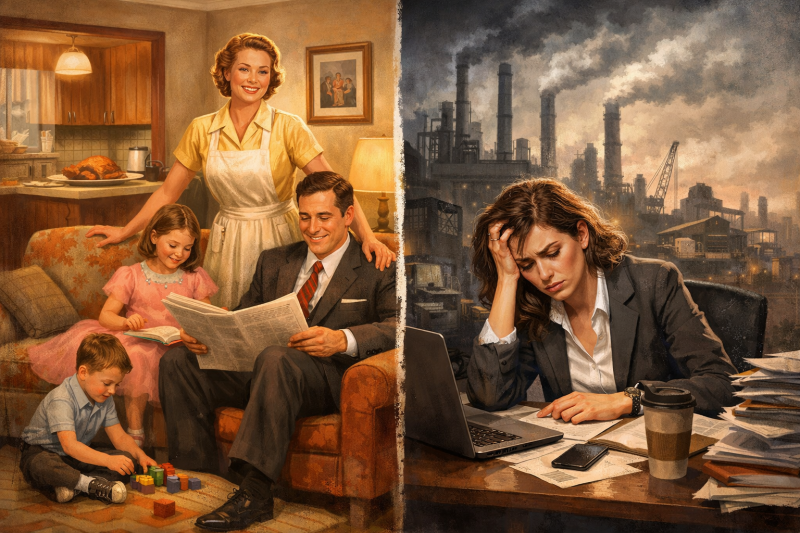
Feminism and the Workforce: The Hidden Economic Consequences No One Talks About
For most of modern history, feminism has been presented as a story of liberation.
Women fought for the right to vote, the right to own property, and the right to participate more fully in society. These were meaningful victories that expanded opportunity and autonomy.
But like many large social movements, feminism didn’t just change women’s rights. It changed the structure of society itself.
And when we step back and look at the bigger picture, it’s worth asking an uncomfortable question:
Did feminism only liberate women—or did it also reshape society in ways that quietly benefited the economic system?
The answer may be more complex than we’ve been told.
⸻
The Industrial Economy Needed Workers
During the Industrial Revolution, factories required massive amounts of labor. Industrialists quickly realized that women represented a largely untapped workforce.
Textile mills in England and early American factory towns relied heavily on female labor. Women were often hired because they could be paid lower wages and trained easily for repetitive factory tasks.
From an economic perspective, this dramatically increased the labor supply.
When more workers enter the workforce, the labor pool expands. This can increase production, fuel economic growth, and create new markets.
In other words, women entering paid labor wasn’t just a social change—it was also an economic expansion.
⸻
The Shift From Family Economy to Individual Workers
Before industrialization, families typically functioned as economic units. On farms and in small trades, husbands, wives, and children often worked together to sustain the household.
Industrialization gradually separated work from the home. Jobs moved into factories and offices, while the home became a separate domestic space.
For a time, Western societies developed what economists called the “family wage” model—the idea that one income could support an entire household while the other partner focused on managing the home and raising children.
But over the 20th century, that structure began to change.
⸻
When the Workforce Doubled
One of the most significant economic shifts of the 20th century was the mass entry of women into the workforce.
This transformation accelerated during and after World War II and expanded dramatically in the 1960s and 1970s as feminist ideas gained mainstream momentum.
From an economic standpoint, the results were enormous.
The labor force grew dramatically.
The number of taxpayers increased.
Household consumption expanded.
Economists frequently point out that women entering paid work contributed significantly to modern economic growth.
But there was another side to the story.
When the number of workers increases dramatically, wages often grow more slowly. Over time, many households began requiring two incomes to maintain the same standard of living that one income once supported.
⸻
The Rise of the “Double Burden”
Another unintended consequence of this shift was something researchers now call the double burdenor second shift.
As women entered the workforce in large numbers, domestic responsibilities did not disappear.
Many women suddenly found themselves balancing two full roles:
• full-time employment
• primary responsibility for household and childcare duties
Rather than replacing traditional expectations, modern women often inherited both sets of responsibilities at once.
For many families, this created new pressures—less time together, more reliance on external childcare, and greater stress in daily life.
⸻
The Cultural Reframing of the Home
Perhaps one of the most subtle changes was cultural.
Over time, domestic life began to be framed differently.
Roles such as homemaking, caregiving, and raising children—once considered essential to society—were increasingly portrayed as limitations rather than valuable contributions.
Success began to be measured largely through career achievement and economic productivity.
Yet the health of families and communities still depends heavily on caregiving, stability, and emotional labor—roles that remain deeply important but are rarely recognized within economic systems.
⸻
Rethinking What Liberation Means
None of this means women should not have careers or opportunities.
Freedom means having the ability to choose one’s path.
But the conversation around feminism may have unintentionally narrowed the definition of empowerment.
True empowerment should not require women to abandon or devalue traditionally feminine roles. Instead, it should honor the full range of ways women contribute to society.
Some women feel called to careers and leadership roles. Others feel deeply fulfilled building families, nurturing communities, or creating homes that anchor the people around them.
Both paths have value.
And perhaps the next stage of the conversation isn’t about rejecting feminism—but about expanding it.
Because true liberation means something simple but profound:
The freedom for women to define their lives for themselves—without being pressured by cultural expectations on either side.
⸻
A More Balanced Future
The deeper question may not be whether feminism was good or bad.
Social movements rarely fit into such simple categories.
Instead, the real opportunity may be learning from history.
Recognizing that economic systems, cultural values, and family structures are all deeply interconnected.
And remembering that progress does not always mean abandoning the past—but sometimes rediscovering the wisdom that once held societies together.
Add comment
Comments