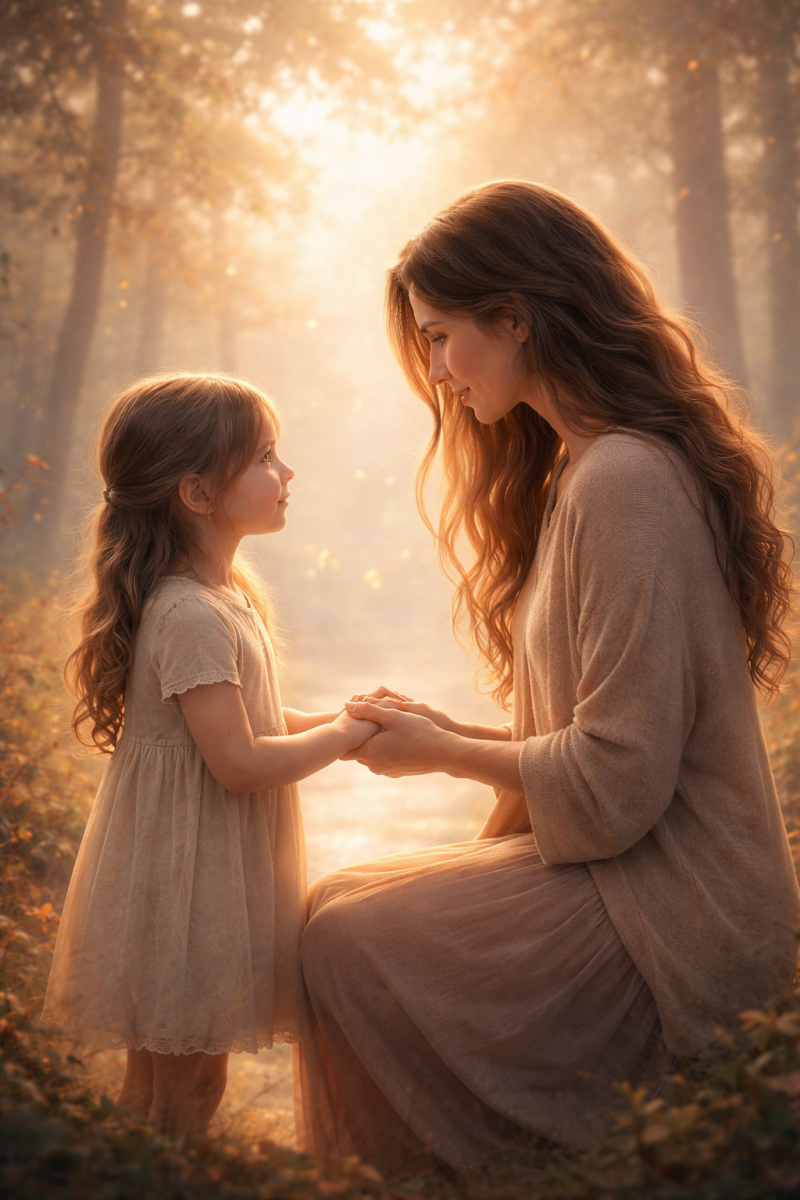
The Invisible Child Becomes the Caretaker
How Growing Up Unseen Teaches Us to Love by Over-Giving
Authors Note
This topic is close to my heart.
Growing up, I didn’t always receive the level of love and attention I needed, and later in life I found myself naturally stepping into the role of caretaker — for friends, partners, and even emotionally for others. For a long time, it felt normal to give more than I received. It took awareness, healing, and a lot of inner work to recognize that while compassion is one of my greatest gifts, it also requires boundaries to remain healthy and sustainable. I share this not because this story is unique, but because I know how many of us are quietly living it.
There is a quiet kind of heartbreak that doesn’t come from obvious trauma, but from something more subtle and just as powerful:
growing up feeling emotionally unseen.
Not necessarily abused.
Not always neglected in visible ways.
But not truly met either.
So many children learn early that their feelings take up too much space, that their needs are inconvenient, or that connection only comes when they are being helpful, mature, or easy to manage.
And so the invisible child adapts.
They don’t stop needing love.
They just learn to earn it.
⸻
When Love Becomes Something You Perform
When a child doesn’t feel consistently safe being emotionally expressed, their nervous system begins to associate connection with effort.
Not rest.
Not receiving.
But doing.
So they become hyper-attuned to the emotional climate around them.
They sense tension before it’s spoken.
They read moods, anticipate needs, smooth over conflict.
Psychology often refers to this as the fawn response — a trauma response where safety is found through pleasing, caretaking, and self-abandonment. Instead of fighting or fleeing, the child learns to survive by becoming what others need.
But spiritually, there is something even more profound happening.
The soul, still full of love, still longing for connection, says:
“If I cannot receive love, I will become it.”
And so the invisible child grows into the caretaker.
The fixer.
The one who always shows up.
The strong one everyone leans on.
Not because they are naturally stronger than others —
but because they learned that being needed was the safest way to stay connected.
⸻
The Wounded Healer Archetype
Many deeply empathetic people carry what spiritual traditions call the wounded healer archetype.
These are the ones who understand pain not from textbooks, but from lived experience. They know how to hold space, how to listen, how to soothe — because they once needed someone to do those things for them.
This can turn into beautiful gifts: compassion, intuition, emotional intelligence, sensitivity to subtle energy.
But it can also become a lifelong pattern of over-giving.
They give time.
They give emotional labor.
They give forgiveness too quickly.
They stay too long.
They pour into people who cannot — or will not — pour back.
And deep down, often unconsciously, there is still a small voice saying:
Maybe this time, if I love enough, someone will finally love me the way I’ve always needed.
⸻
Why Rest Feels Unsafe
Neuroscience tells us something important here.
When emotional needs are inconsistently met in childhood, the brain wires connection with vigilance. The body learns that love is unpredictable, so it stays alert. Always scanning. Always adapting.
This is why so many caretakers struggle with:
• Letting others help them
• Asking for what they need
• Trusting that they won’t be abandoned if they stop performing
Their nervous system doesn’t recognize ease as safety.
It recognizes usefulness as safety.
So even in adulthood, even in relationships, they may feel uncomfortable receiving without giving something back immediately. They may feel guilty resting. They may feel anxious when they are not being productive or emotionally supportive to someone else.
They don’t just want to be loved.
They want to be valuable.
Because somewhere along the way, worth became tangled up with service.
⸻
The Hardest Truth: They’re Not Trying to Be Strong
From the outside, caretakers look resilient.
They seem capable.
Stable.
Unshakeable.
But the hardest truth is this:
they are not trying to be strong.
They are waiting.
Waiting for someone to finally do for them what they have spent their whole lives doing for everyone else.
Waiting to be chosen without proving.
Waiting to be supported without collapsing first.
Waiting to be loved without performing.
And this waiting can keep them in relationships that feel familiar rather than safe. Relationships where they are needed, but not deeply seen. Where they give more than they receive, but tell themselves that love always requires sacrifice.
Until one day, something in the soul begins to shift.
⸻
When Healing Changes the Assignment
Awakening doesn’t always arrive as bliss.
Sometimes it arrives as exhaustion.
As resentment.
As the quiet realization that you are tired of being the one who always understands, always forgives, always holds it together.
This is the moment the soul whispers:
Love was never meant to cost you yourself.
Healing begins when the caretaker starts asking different questions.
Not:
“How can I help?”
“How can I fix this?”
“How can I be enough for them?”
But:
“How do I feel when I’m with them?”
“Do I feel safe to be human here?”
“Am I allowed to rest in this connection?”
This is not selfishness.
This is self-reclamation.
This is the moment love stops being something you prove…
and becomes something you are finally willing to receive.
⸻
From Trauma Bonds to Resonant Bonds
When over-giving is your baseline, it’s easy to bond through struggle.
Through shared wounds.
Through rescue dynamics.
Through intensity.
But as the nervous system heals, it begins to crave something different.
Peace.
Consistency.
Mutual effort.
And at first, that can feel unfamiliar — even boring — to a body that equates love with emotional labor.
But spiritually, this is the soul remembering its true nature.
You were not designed to be everyone’s safe place while having nowhere soft to land yourself.
You were not meant to survive love.
You were meant to rest inside it.
Healing shifts you from trauma-based bonds to resonant bonds — connections where energy flows both ways, where care is mutual, where you do not have to earn your place by overextending yourself.
⸻
The Return to the Self
Perhaps the most powerful part of this journey is not learning how to love others better —
but learning how to finally love yourself with the same devotion you’ve always given away.
To listen to your own body.
To protect your own energy.
To honor your own limits.
This is not about becoming colder.
It is about becoming whole.
The invisible child does not disappear.
They are finally seen — by you.
And when you stop abandoning yourself, the universe responds in kind.
It begins sending people who do not need to be rescued…
only met.
⸻
Closing Reflection
If you have spent your life being the strong one, the healer, the emotional anchor for everyone else —
please know this:
Your softness is not a liability.
Your sensitivity is not weakness.
And your love was never meant to be a transaction.
You are allowed to receive the care you so freely give.
You are allowed to choose relationships that nourish instead of drain you.
You are allowed to stop proving your worth through exhaustion.
And perhaps the deepest healing of all…
is realizing that you were never invisible to the universe —
only learning how to finally be visible to yourself
Add comment
Comments